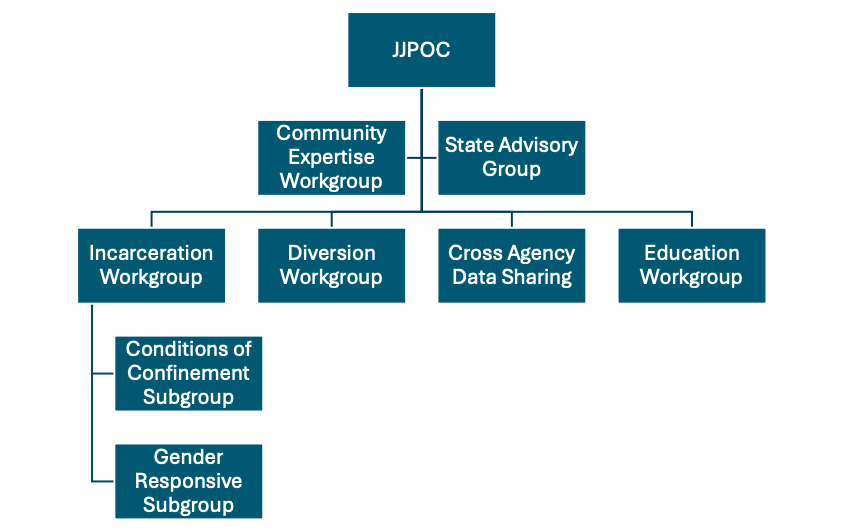
The University of New Haven’s Tow Youth Justice Institute supports the JJPOC through staffing, research, and coordination of efforts. The work of the JJPOC has been largely conducted through six workgroups: Diversion, Incarceration, Racial and Ethnic Disparities (RED), Community Expertise, Education, and Cross-Agency Data Sharing. The workgroups are comprised of state, local, private, not-for-profit, and advocacy agencies who collaboratively develop system-wide and research driven strategies to improve youth justice in the state of Connecticut.
[/delaware_section_title]
The chart reflects the workgroup structure of the JJPOC that was updated in 2018 during the strategic planning process. Subgroups are identified as needed when a component of the work is deemed in need of having a dedicated group focused on the issue. Descriptions of the workgroups are below.
[delaware_empty_space height=”70″]
[delaware_section_title select_type=”7″ title=”Diversion” heading=”h3″ size=”30″ weight=”500″ underline_check=”1″ el_class=”jjpoc-header”]The Diversion Workgroup is dedicated to enhancing public safety by creating youth diversionary strategies focused on three core components: developing formal policies that establish clear pathways for diverting youth from the justice system, identifying and scaling evidence-based practices that address underlying needs and reduce recidivism, and delivering targeted training to ensure that these approaches are understood and applied consistently and equitably by law enforcement, justice staff, and community partners.[/delaware_section_title]
[delaware_empty_space height=”70″][delaware_section_title select_type=”7″ title=”Education” heading=”h3″ size=”30″ weight=”500″ underline_check=”1″ el_class=”jjpoc-header”]Education Workgroup is dedicated to reducing the risk of future youth justice system involvement by promoting equitable access to education for all youth involved in the justice system, fostering academic efficacy and achievement and reinforcing positive educational protective factors through strategic engagement and comprehensive support.[/delaware_section_title]
[delaware_empty_space height=”70″][delaware_section_title select_type=”7″ title=”Incarceration” heading=”h3″ size=”30″ weight=”500″ underline_check=”1″ el_class=”jjpoc-header”]The Incarceration Workgroup is designed to ensure systema and facilities are responsive to the developmental needs of youth and have programming available which provides a pathway for youth to thrive and be successful in life. This is accomplished by creating a system that prioritizes the well-being and successful reintegration of youth, ensure that systems and facilities are not only safe and humane but also actively promote the healthy development, thus resulting in developing responsive practices included tailor interventions and programs to support the youth’s physical, emotional and cognitive growth by treating children as children to ensure appropriate services and providing opportunities for education and skill-building.[/delaware_section_title]
[delaware_empty_space height=”70″][delaware_section_title select_type=”7″ title=”The Racial and Ethnic Disparities (RED)” heading=”h3″ size=”30″ weight=”500″ underline_check=”1″ el_class=”jjpoc-header”]The Racial and Ethnic Disparities (RED) Workgroup is tasked with evaluating the application of police responses, legal policies, and practices regarding young people and their impact on youth of color, in order to eliminate disparities. This is accomplished by proactively addressing inequities entrenched within the juvenile justice system. The workgroup focuses on developing strategies in partnership with communities of color and ensuring collection, interpretation, transparent public reporting, and review of race and ethnicity data at every crucial point of contact.[/delaware_section_title]
[delaware_empty_space height=”70″][delaware_section_title select_type=”7″ title=”Cross Agency Data Sharing” heading=”h3″ size=”30″ weight=”500″ underline_check=”1″ el_class=”jjpoc-header”]The Cross Agency Data Sharing Workgroup works to support comprehensive data requests from the JJPOC Workgroups and the JJPOC Committee, as well as to support annual state agency presentations and prepare the annual state of the system report. The Cross Agency Data Sharing Workshop pulls together data experts in their relative fields and agencies to respond to data inquiries to the Committee and Workgroups exploring specific initiatives and understanding outcomes. [/delaware_section_title]
[delaware_empty_space height=”70″][delaware_section_title select_type=”7″ title=”Community Expertise Working Group” heading=”h3″ size=”30″ weight=”500″ underline_check=”1″ el_class=”jjpoc-header”]The Community Expertise Working Group works to empower youth, families, and communities to shape JJPOC decision-making, ensuring the voices and perspectives of those impacted by the system are included. This group consists of individuals with firsthand experiences of policies in action, who will inform and educate JJPOC members and guide JJPOC legislative recommendations. They will also be tasked with examining existing practices to encourage and support authentic community participation[/delaware_section_title]